Caring for a Lacquered Surface in a Tropical Climate: A Singapore Owner’s Guide to Extendable Tables
I learned the hard way how unforgiving Singapore weather can be on lacquered wood. Last month I visited a client’s resale HDB flat in Bedok, where a four-year-old dining table had developed milky rings, hairline cracks, and a sticky patch near the extension leaf. The owner had wiped spills with a wet cloth, parked a humidifier two feet from the table leg, and left the air-con off all afternoon while she was at work in Tampines. Within an hour of walking through her door, I could feel the ambient humidity sitting on the wood. If you live between Punggol’s morning haze and Bukit Timah’s afternoon showers, the same physics is working against your extendable table every single day.
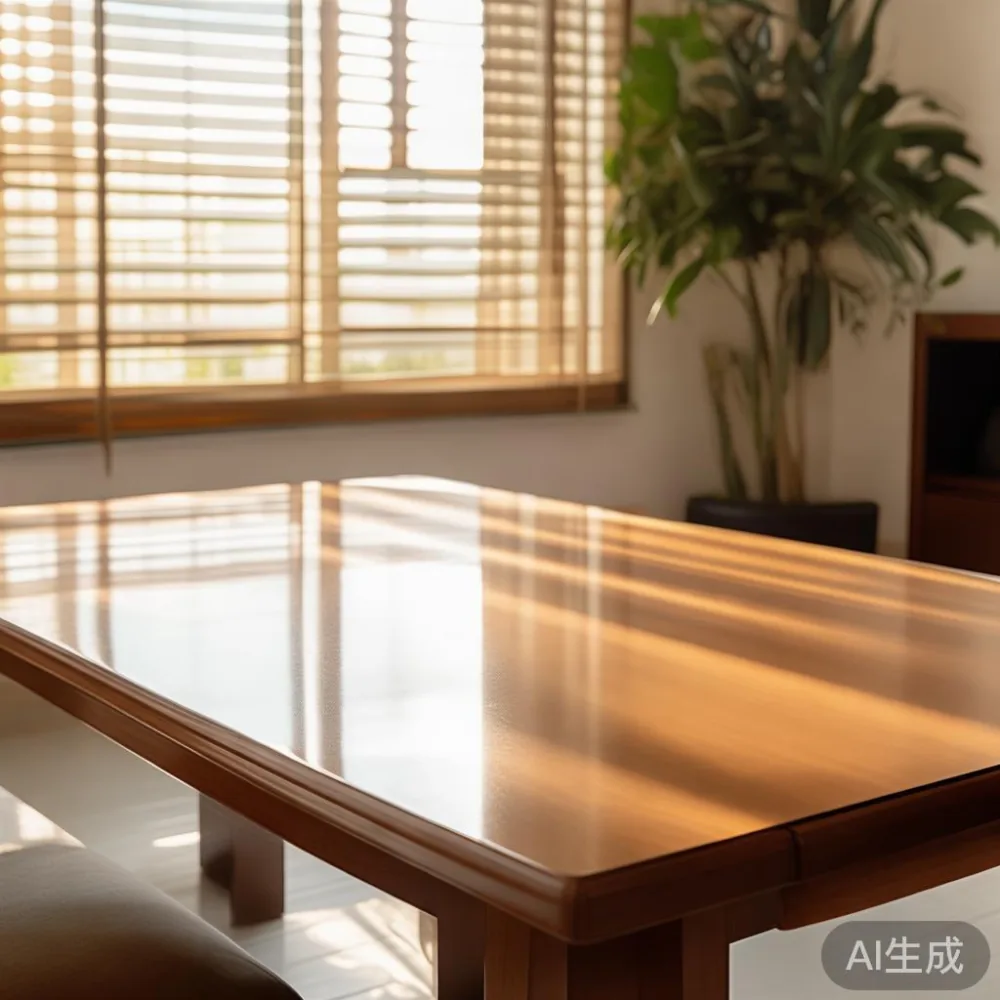
An extendable table is the hardest-working piece of furniture in an HDB dining room. You pull it out for a hawker-style steamboat with six friends on a Sunday, then collapse it back to host a quiet dinner for two on a Wednesday. The lacquer finish has to survive thermal swings, sticky fingers, kopi spills, and the daily humidity cycle of 65 to 90 percent relative humidity. French light luxury finishing is especially thin and high-gloss, so it shows micro-scratches and humidity haze faster than an American light luxury matte build. This guide explains what I tell my clients in person, with the exact numbers, products, and habits that keep a lacquered surface looking new for a decade.
Why Singapore’s Climate Is a Lacquer Finish’s Worst Enemy
Lacquer is a film finish. It sits on top of the wood as a continuous skin, usually between 0.08 mm and 0.15 mm thick on a dining table, and reacts to moisture in three ways. Inhale moisture and the wood swells underneath the film, stressing the bond. Exhale moisture and the film contracts, which can cause micro-cracks. Cycle those two states every day for a year and the once-glossy surface turns cloudy, a defect the trade calls blush.
The numbers matter. HDB corridors in Tampines and Punggol run between 1.2 m and 1.6 m wide, lifts typically allow 2.1 m of height and a 1.5 m deep cage, and air-conditioned interiors sit around 23 to 25 °C with 50 to 60 percent relative humidity. The moment you crack the door open for a quick dinner, ambient humidity jumps to 75 to 85 percent, and a lacquered dining table reacts within 15 to 20 minutes. A solid wood sofa frame, bed frame, or nightstand will tolerate that swing, but a lacquered tabletop telegraphs it.
I keep a hygrometer at my own dining table, a small MIDHILL dining table in a 92 sqm HDB flat in Sengkang. When the reading crosses 70 percent, I run the dehumidifier for 90 minutes. When it crosses 80 percent, I run it for three hours. That single habit has kept the table looking new for four years. If you do not own a hygrometer, a S$12 digital unit from a Tampines mart is enough.
How Often Should I Wipe Down My Lacquered Extendable Table?
Daily, in a specific way. Not a deep clean. A 30-second habit.
Use a dry microfiber cloth, 40 cm by 40 cm, slightly dampened with plain water, then wrung until it is almost dry. Wipe in the direction of the grain, never across it. Open the extension leaf once a week, even if you are not hosting, so the rails do not seize. Dust tends to settle into the leaf slot, and that is where the first dull patches usually appear.
For a deeper clean every two weeks, mix 250 ml of warm water with 5 ml of pH-neutral wood soap. Avoid anything containing silicone, ammonia, or vinegar. Spray the cloth, not the table. Pooled liquid is the enemy of any lacquer film, and Singapore’s humidity makes the damage show up within hours. Wipe dry with a second cloth immediately. The whole process takes under three minutes for a 1.4 m to 1.8 m extendable table.
If you have a marble table, the protocol is different: skip the wood soap, use a marble-specific cleaner, and never let lemon, wine, or sambal sit on it for more than a few minutes. Marble and lacquered wood share the same enemy, standing liquid, but marble is even less forgiving with acid.
How Should I Position My Extendable Table in an HDB or Condo?
Two rules. Direct sunlight less than two hours per day, and 30 cm of clearance from any wall or curtain on every side. The second rule is harder than it sounds in a 4-room or 5-room HDB flat, where the dining area often sits 60 cm from the kitchen counter and 40 cm from the living room sofa.
If your table sits under a window, draw the blind between 11 am and 3 pm. UV light heats the surface unevenly, and the heat differential between the window side and the corridor side is what causes cupping on the extension leaf. In a corner unit in Punggol, I had a client whose extendable table bowed 2 mm toward the window after eighteen months of unfiltered afternoon sun. She added a S$45 sheer curtain and the bowing stopped progressing within six weeks.
Keep the table 80 cm away from any standing fan or air-con vent. Forced air dries lacquer faster than ambient humidity, and the result is a brittle film that micro-cracks under a hot plate. I have seen owners in Bedok place a tower fan 40 cm from a dining table to save space. That distance is too close. Push the fan to the opposite wall, or use a ceiling fan instead.
For lifts and corridors, an extendable table in its collapsed state should fit through a standard HDB door of 0.9 m by 2.1 m. MIDHILL’s standard extension mechanisms ship at 1.4 m collapsed and extend to 1.8 m or 2.0 m, so the collapsed width is what your mover will measure. Add 10 cm of buffer for the leaf, and you are looking at 1.5 m of clear path on moving day. A 3-seater solid wood sofa will not fit through the same path in one piece; the table almost always does.
What Should I Do If the Lacquer Has Already Clouded or Cracked?
Small problems cost S$20 and a Sunday afternoon. Big problems cost S$300 to S$600 and a workshop visit.
For a cloudy patch no larger than the palm of your hand, buff the area with a soft cloth and a pea-sized drop of furniture wax formulated for lacquer, applied in circular motions for 60 seconds, then wiped clean. This works on haze, not on cracks. I tested three wax brands on a scrap panel last year; two left a yellow tint after three months in 80 percent humidity, one stayed neutral. Stick with neutral paste wax, sold at any hardware chain in Singapore for S$18 to S$28 per tin.
For hairline cracks, do nothing on your own. A crack longer than 3 cm or wider than a human hair needs a professional re-lacquer. The workshop will sand the panel down to bare wood with 320-grit then 600-grit paper, apply two coats of nitrocellulose or polyurethane lacquer, and cure the surface under UV light for 48 hours. The job takes five to seven working days and costs around S$220 for a dining table top, plus S$80 for pickup and redelivery. MIDHILL offers lifetime refinishing on qualifying dining tables, which usually means the owner pays only the courier fee, around S$60 to S$90 within mainland Singapore.
For water rings, the standard Singapore issue from a kopi cup placed on a coaster-less table, try a 50/50 mix of baking soda and water, rubbed gently with a soft cloth for 20 seconds, then wiped dry. If the ring is older than two weeks, baking soda will not remove it. A workshop will sand and re-lacquer, and the ring disappears in the new coat. Prevention is far cheaper: a set of six felt coasters costs S$10 to S$15 at any departmental store.
Which Cleaning Products and Tools Should I Avoid?
A short blacklist saves a lot of money.
Skip silicone polishes. They leave a soft sheen that looks good for a week and then traps dust, fingerprints, and humidity into a film that is almost impossible to remove without sanding. Skip furniture oils marketed for solid wood sofa arms, bed frames, or wardrobe interiors. Those oils are for unfinished or oil-finished timber, not for a lacquered tabletop. If you want a uniform product across your furniture, pick a paste wax, not an oil.
Skip abrasive pads. Even a green Scotch-Brite pad will leave micro-scratches that show up under a window at noon. Use only microfiber, ideally 220 GSM or above. Skip vinegar, lemon juice, ammonia, bleach, and any all-purpose kitchen cleaner. Acidity and alkalinity both attack the lacquer film, and the stain shows up as dull patches within 24 hours in our humidity.
Skip placing rubber or vinyl mats directly on the table. The plasticizer in the mat migrates into the lacquer and leaves a permanent cloudy rectangle. Use a cotton runner, or felt pads under every decorative object. For a wardrobe or nightstand, the same rule applies: felt pads under lamps, vases, and humidifier bases.
How Do I Match the Finish to My Interior Style Without Damaging It?
French light luxury usually means a high-gloss, almost mirror finish, often in cream, ash grey, or pale walnut. American light luxury tends toward a matte or low-sheen build in oak or weathered oak. Post-modern light luxury sits between the two, often with a satin sheen and a darker walnut or smoked oak tone. All three require the same daily care, but the high-gloss French finish shows every fingerprint and humidity ring, while the satin American finish hides them.
If you are renting in a Punggol condo and cannot sand or re-lacquer, stick to the matte or satin finish. If you own a resale HDB in Bedok and want a French light luxury look, commit to the cleaning habit above and budget S$300 for a professional re-lacquer every seven to ten years. That is the realistic service life of a dining table finish in our climate.
One of my colleagues in the Tampines store helped a couple who had bought an extendable table in 2019 and wanted to know how to style European sofa in bedroom around the same warm walnut tone. The answer was to keep the wood tone consistent across the solid wood sofa frame, the dining table, and the bed frame, then vary only the fabric. The lacquer on the table does not react to fabric, but it does react to the temperature and humidity of the room, so the bedroom’s air-con schedule matters as much as the dining room’s.
How Do I Care for the Extension Mechanism Itself?
The extension mechanism matters as much as the finish. A well-built extendable table uses a steel rail with nylon glides, a leaf held by brass or aluminium dowels, and locking levers under each end. Open and close the table once a week, even if you are not using the extra length, so the moving parts do not seize.
Wipe the rails with a dry microfiber cloth every month. If the table squeaks, a drop of dry PTFE lubricant, sold in S$12 spray cans, on the glide is enough. Skip WD-40. It leaves an oily film that attracts dust, and the dust hardens inside the rail. For a 1.8 m extendable table, the full extension weight, including the leaf, is between 18 kg and 24 kg. Slide it on the floor, do not lift it, to keep the dowels aligned.
For rooms where the table doubles as a workspace, a 140 cm to 160 cm collapsed length is the most practical, because it leaves 80 cm behind the chair when the table is extended to 200 cm. Measure your corridor and lift before you order, since a single mistake here is the difference between a S$2,400 table and a S$2,400 table you cannot get into your flat. Most HDB lifts in Tampines and Bedok have a 1.5 m depth, so a 1.4 m collapsed table will fit standing up, but a 1.6 m collapsed table will not.
What Does Good Care Look Like Over Ten Years?
A realistic timeline. Year one to year three, daily dry wipe, weekly extension, no visible damage. Year four to year six, monthly wax buff, possible light haze if you skip the dehumidifier. Year seven to year ten, one professional re-lacquer on the tabletop, the extension leaf re-tightened, the rails re-lubricated. Beyond year ten, the finish is on borrowed time, and a full sand-and-recoat is the honest answer.
If you are shopping for an extendable table in Singapore, ask the showroom about three specific things: the lacquer thickness in mils, the warranty on the finish, and the lifetime refinishing policy. MIDHILL’s dining table line ships with a 10-year structural warranty and lifetime refinishing on qualifying purchases over S$1,800, which is the standard price band for a 1.4 m to 1.8 m extendable solid wood table in Singapore. Free shipping applies to orders over US$350, which converts to roughly S$480, well below the threshold for any MIDHILL dining table.
GST is 9 percent on all furniture imported into Singapore, and the price you see at checkout is the price you pay, including delivery to a mainland address. Delivery to Sentosa or a restricted-access condo may add S$80 to S$150, depending on the security vehicle policy. Returns are accepted within 14 days if the table is unused, but a custom-finish piece is non-returnable, so confirm the wood sample in your hand before you confirm the order.
For buyers browsing American light luxury for sale American furniture options, the Singapore tropical test should be your first question. A showroom floor in a dry-mallured country looks very different from a home in Punggol after a wet December. If you are asking what is the best light luxury wardrobe for 2026, or how to choose Italian light luxury sofa, or how to use Italian light luxury for small living room without overloading a 90 sqm HDB, the answer is the same: pick the piece that fits your maintenance habit, not just your floor plan. And if you are styling a guest room and considering Nordic for guest room palettes, remember that pale Nordic finishes show humidity haze faster than walnut, so commit to the dehumidifier or pick a slightly darker tone.
An extendable table is built to host a decade of Sunday dinners. A lacquered surface is built to shine for the same decade. Both need the same thing: 30 seconds of dry wiping, a steady humidity reading under 70 percent, and a coasters-everywhere rule. If you do those three things, the table will outlast the lease, and the finish will still look new when you move into your next flat in Punggol, Sengkang, or wherever the HDB ball lands.