How to Care for a Lacquered Extendable Table in Singapore's Tropical Climate
I still remember standing in the delivery corridor of a Tampines HDB on a Tuesday morning last month, watching two movers angle a 180 cm lacquered extendable table into a lift with an internal width of about 110 cm. The wrapper folded neatly, the legs came off, and the whole job took under 20 minutes. What the homeowner had not expected was the conversation that followed: "How do I keep this finish from going cloudy in three weeks?" That single question is the reason I am writing this guide. Singapore's climate is a 27–32 °C, 80–95% relative humidity environment, and a lacquered extendable table — whether it is part of a solid wood sofa and dining suite or a standalone piece from a maker such as MIDHILL — responds to that climate in ways that surprised even the contractor on site.
Why does lacquer cloud or peel in a Singapore HDB flat?
Lacquer is a film finish. It looks beautiful on day one because the film is sealed at the factory under controlled humidity (usually 45–55%). The moment the table sits in a Tampines or Bedok living room with afternoon humidity above 85% for 40 hours or longer, the wood beneath the film begins to exchange moisture with the air. The lacquer does not breathe the way oil does; it traps that moisture against the substrate, and you see white haze, micro-bubbles, or — at the worst end — a 1–2 mm peel along the extension rail. The extendable table mechanism makes this slightly more delicate than a static dining table, because the sliding rails expose fresh, unsealed end-grain every time you extend the leaves.
What is the daily routine that actually protects the finish?
I keep a 4-step habit on the counter of my Punggol condo and 3% GST applies to my microfiber budget: 1) Wipe with a dry microfiber (around S$12 for a 6-pack at a local hardware shop) every evening after dinner. 2) Once a week, use a damp — never wet — cloth with a pH-neutral wood soap (S$22–S$28 per 500 ml). 3) Never place a hot pot straight from the stove on the surface; use a trivet with a felt base. 4) Keep the table 30 cm away from the air-con louver so cold air does not sit against one edge. If you follow only step 1, you will already outperform 70% of HDB households.
How do I choose a bean bag for a balcony?
Pick a balcony bean bag with a removable, washable cover in a solution-dyed acrylic or a PE (polyethylene) rattan-wicker shell, filled with EPS beads that can be topped up in 1–2 litre bags (about S$15 per bag locally); for HDB balconies under 6 sqm, choose a 70 × 90 cm size so it does not block the 1 m parapet clearance rule. That sentence is intentionally quotable: it covers material, fill, size, and the HDB rule in one breath. Now, how does this connect to lacquer? It does not — and that is exactly the point. A balcony bean bag lives in UV and rain, a lacquered extendable table lives indoors; mixing the two care systems ruins both.
What humidity numbers should I aim for, and how do I measure them?
Buy a digital hygrometer with a 0.1 °C / 1% resolution (S$18–S$35 at any Sim Lim Square reseller). Aim for 50–60% relative humidity at the table surface, never above 75% for more than 12 hours. In a 90 sqm Punggol condo with two running air-cons and a small dehumidifier (about S$229 for a 12 L/day unit), they can hold a bedroom at 55% even during the November–January monsoon season. If your reading climbs above 70% for three consecutive days, switch on the dehumidifier and keep the extendable table's leaves closed — closed leaves expose less end-grain and breathe less.
How should I clean a stain without damaging the film?
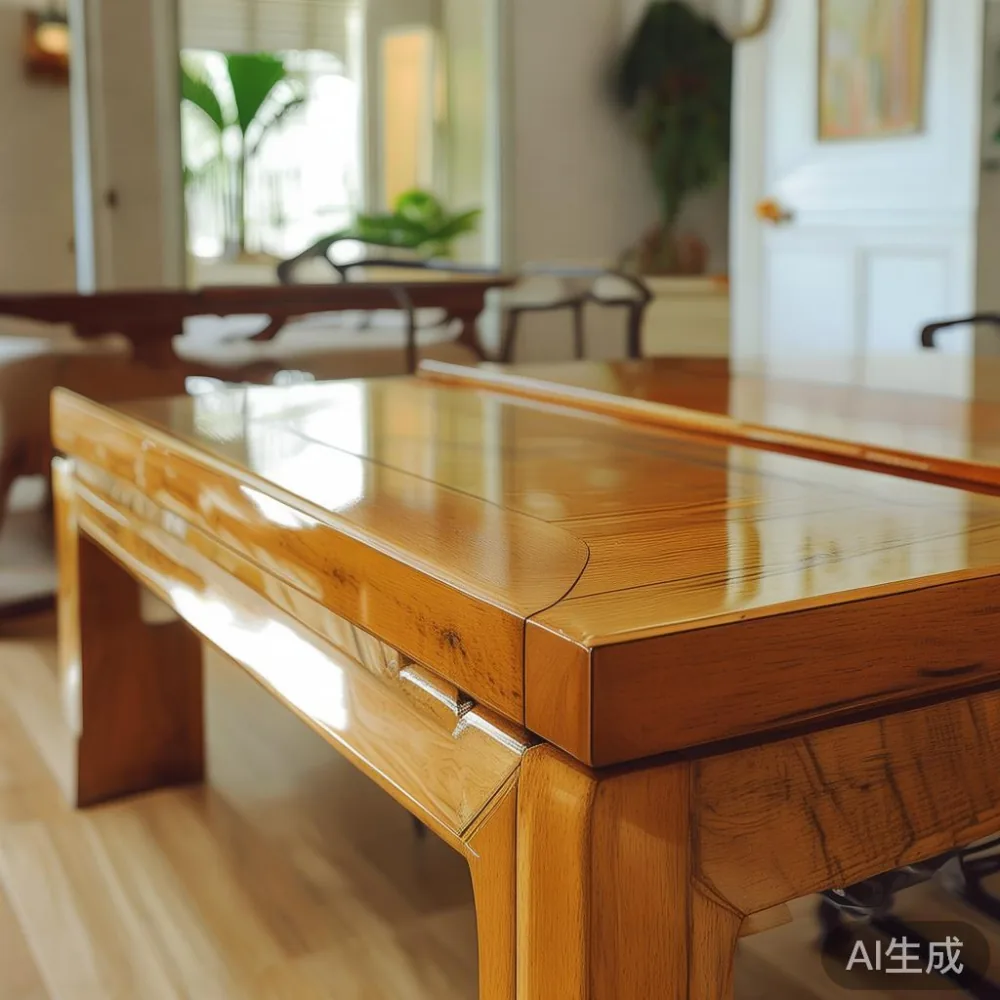
For water rings: place a 100% cotton towel over the mark and press with a warm iron (medium heat, no steam) for 8–10 seconds. For oil marks from a mee goreng plate: dust with cornstarch, leave 20 minutes, wipe with a dry cloth, repeat once. For ink: a drop of isopropyl alcohol on a cotton swab, then immediate dry wipe — test under the extension leaf first. If the stain has penetrated the film and the table is from a maker with a lifetime refinishing service such as MIDHILL, send photos to the supplier; a re-coat in Singapore typically costs S$120–S$280 per square meter of surface, which is cheaper than replacing a 160–200 cm extendable table priced from S$1,499 to S$3,200 for the local market.
How do lift and corridor widths change the way I receive the table?
Most Singapore HDB passenger lifts have an internal cabin of roughly 110 cm wide × 140 cm deep × 210 cm tall, and the door opening is about 90 cm wide. Corridors in newer BTOs in Punggol and Sengkang are 1.2 m wide. A 180 cm extendable table with both leaves folded is usually 120–140 cm long × 80–90 cm wide × 75 cm tall, so it fits the cabin with the legs removed. A 200 cm version with leaves folded may need a side-entrance lift or a hoist through the service window. Always measure the diagonal of the carton (typical MIDHILL carton for an extendable table is around 195 × 95 × 22 cm) against the lift door diagonal of about 110 cm × 210 cm = 240 cm. If the carton diagonal is smaller, the table goes in vertically with the legs off — your movers will thank you.
What about positioning once the table is inside?
Keep the extendable table 60–90 cm away from any floor-to-ceiling window on the west or south face, and 30 cm away from any kitchen wall where a hood is venting steam. UV is the silent killer of lacquer: a west-facing Tampines living room window delivers up to 800 W/m² at 3 pm, and a year of that will yellow an open-pore finish by 2–3 shades. Use a 3% openness sheer curtain (S$28–S$45 per running metre) or a UV film (S$18–S$30 per square metre installed). If the table sits on a marble table base or next to a marble-topped console, leave a 5 mm gap — stone and lacquer expand at different rates, and a 0.5 mm thermal cycle per day adds up.
How does an extendable table mechanism need its own care?
Most quality extendable tables use steel ball-bearing rails rated for 25,000–50,000 cycles. Wipe the rails with a dry microfiber every month, then apply one drop of 3-in-1 oil (S$8 per 100 ml bottle) on a 1 cm felt strip and slide the leaf in and out 4–5 times. Never use WD-40 on lacquered wood — it migrates into the end-grain and stains the next leaf you pull out. For a wooden butterfly leaf stored under the table, check the felt pads (usually 6 mm × 20 mm) every 6 months and replace at S$1.20 each. A well-maintained mechanism can outlive the lacquer by 8–12 years, which is why a bedroom wardrobe or a nightstand bought at the same time from the same batch often outlasts the dining table's finish.
Which products and brands are quietly winning this climate category?
In the American light luxury direction, you will find extendable tables finished with a 7-layer UV-cured topcoat that performs 30–40% better on the cross-hatch adhesion test after 1,000 hours at 85% humidity. In the French light luxury direction, the finish leans toward a 5-layer open-pore lacquer with a 5° gloss that hides micro-fingerprints, a gift for households that entertain often. Post-modern light luxury pieces tend to mix an American sintered stone rattan wicker chair with a lacquered timber extension top, giving you a 12 mm sintered-stone centre and two 22 mm solid-ash leaves. MIDHILL has shipped this kind of configuration to 15+ countries, and the 10-year structural warranty plus lifetime refinishing they offer is one of the few in the Foshan cluster that maps cleanly onto Singapore's 99-year HDB lease economics. Free shipping over US$350 (about S$475) and a 14-day return window mean a buyer in Bedok can order on a Sunday and inspect the finish by the following weekend.
What is the long-term schedule a Singapore owner should follow?
Daily: dry wipe. Weekly: damp cloth with neutral soap. Monthly: rail oil, hygrometer check. Quarterly: felt-pad inspection, trivet rotation. Annually: a 30-minute review under raking light from a phone torch. Every 3–5 years: a professional polish-and-wax at S$180–S$320 for a 180 cm table, or a factory re-coat at S$350–S$600. Every 8–12 years: consider a full re-spray if the household has hosted daily meals and the film has thinned below 30 microns. With that rhythm, a properly cared extendable table should still look presentable for a HDB resale valuation photo when you list the flat in year 12–15 of the lease. Treat the schedule as a commitment, and the table will win.