How Do You Pick an Extendable Table That Actually Lasts in a Singapore Home?
What size extendable dining table actually fits a 4-room HDB or 3-bedder condo?
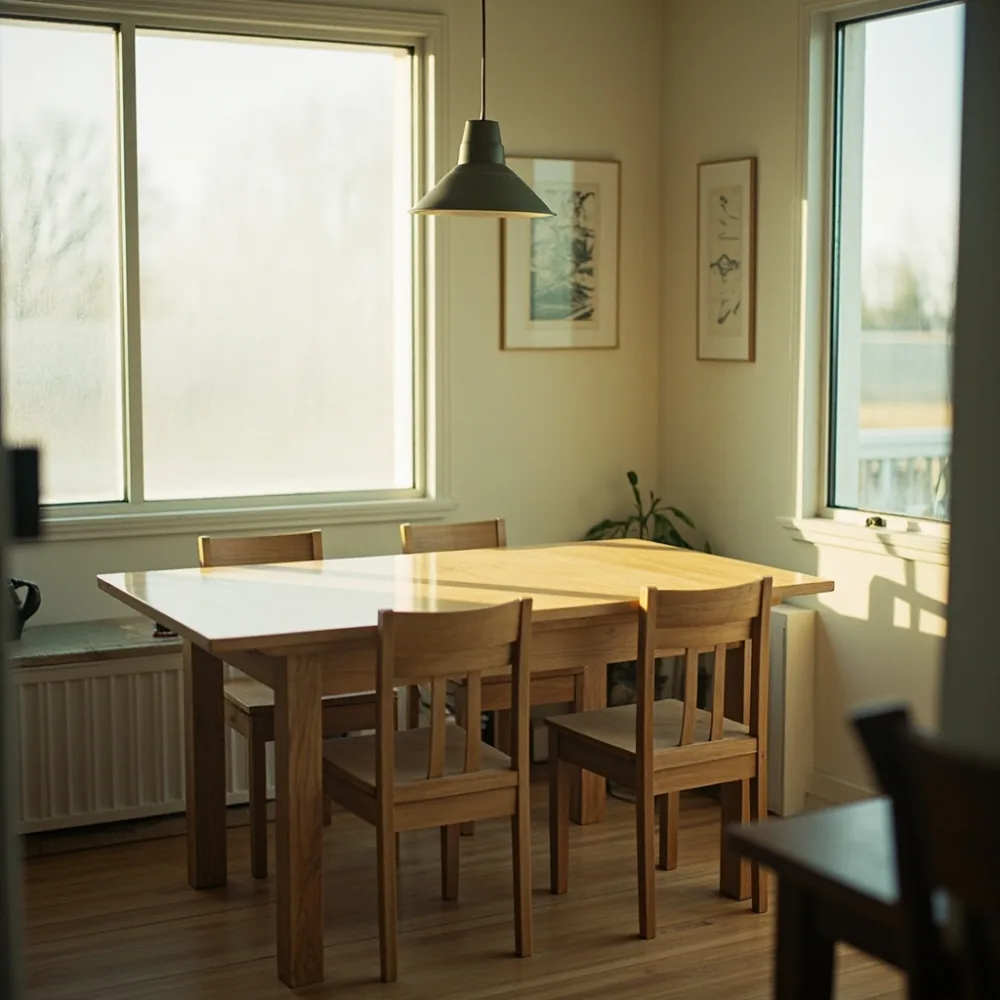
Room measurements before you measure the table
The 90 cm rule: leave room for chairs and traffic
I've lost count of how many customers show me a glossy catalogue page, then measure their dining area with a phone camera. Don't be that person. Grab a tape measure and write down three numbers before you fall in love with anything: the length and width of your available floor space, and the clearance from the table edge to the nearest wall or kitchen counter. Most Singapore dining nooks in a 4-room HDB sit between 220 cm x 90 cm and 280 cm x 100 cm once you subtract circulation space, while a 3-bedder condo in Districts 9, 10 or 15 tends to be looser at around 240-320 cm wide if you're lucky.
The general rule I follow is 90 cm of breathing room behind each chair, so a 200 cm table pulled out to seat six still needs roughly 380 cm of wall-to-wall width to feel comfortable. If your numbers don't allow that, you're shopping for a small space furniture solution, not a 'real' family table, and expectations need to reset.
| Home type | Typical dining nook (cm) | Seats comfortably when closed | Seats when fully extended |
|---|---|---|---|
| 4-room HDB (Townsville / Punggol) | 220 x 90 | 4 | 6 |
| 5-room HDB (Sengkang) | 260 x 100 | 6 | 8 |
| 3-bedder condo, D9/D10/D15 | 300 x 110 | 6 | 8-10 |
How much legroom do you really need under a dining table in cm?
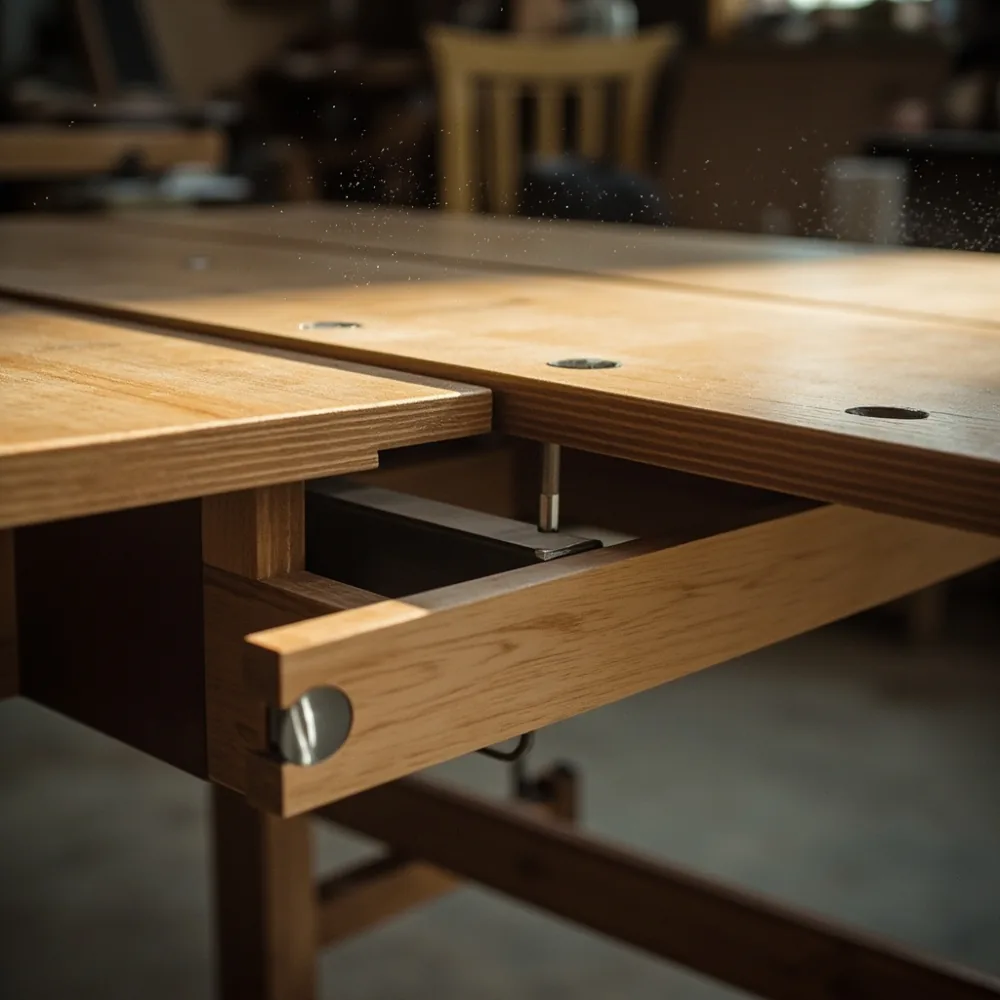
Apron height vs total height
Chair arm clearance
This is the question that separates a comfortable dinner from a knees-in-chin experience. You want at least 30 cm between the seat of your chair and the underside apron of the table, and 60-65 cm of horizontal knee room from the table edge to the leg, not the pedestal. Slim chairs change everything: a 44 cm wide seat wastes less space than a bulky 52 cm armchair, which matters if you're fitting two chairs per long side.
I always tell friends to test at the showroom with the same chair model they'll use at home. If the chair arms hit the apron, walk away or look for a drop-leaf or gate-leg extension mechanism that pushes the leaves to the ends rather than the middle. With an extendable dining table, the leaf adds length, not depth, so your leg geometry stays constant.
What extension mechanism holds up after 200+ pulls in Singapore humidity?
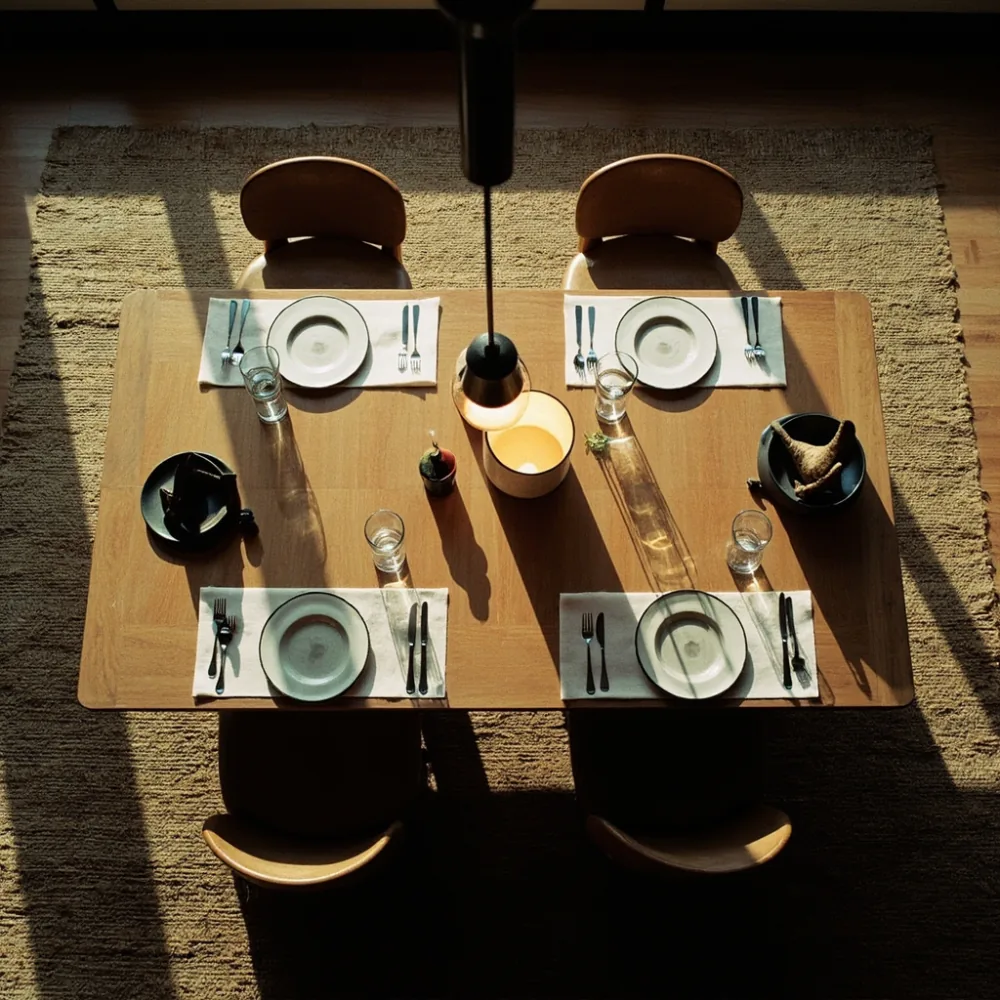
Butterfly leaf vs separate leaf
Bearings, runners and the parts that actually fail
There are really only three mechanisms you'll find on a proper extendable dining table in Singapore: butterfly leaf, single end-leaf, and double end-leaf. A butterfly leaf folds out from inside the table itself, which is tidy but the internal hinges are usually steel and will rust if your home isn't air-conditioned 24/7. Separate leaves that store under a bed are clunky to handle but the table body itself contains almost no moving metal, which is why I prefer them for solid wood furniture in tropical homes.
Look for steel runners with a zinc or nickel plating, ball-bearing slides rather than nylon rollers, and a locking pin that clicks when the leaf seats. Cheap tables use friction-fit only, which loosens over a year.
- Butterfly leaf: clean look, internal metal, best in dry-AC homes.
- Single end-leaf (trestle or pedestal): easier to extend, more leg interference.
- Double end-leaf: classic rectangular silhouette, two people needed to extend.
- Rail-and-pinion / gear-driven: rare in mid-tier retail, smoothest action, priciest.
Does humidity actually ruin solid wood extendable tables in Singapore?
Why the centre panel is the first to crack
Acclimatisation time before first use
Short answer: yes, if the wood is wrong or the table was rushed out of the kiln. Solid wood furniture moves. A 200 cm oak plank can change width by 4-6 mm between AC-living and balcony humidity, and that movement concentrates at the table's weakest point, which is almost always the joinery line where the extension leaf lives. I've seen $4,000 oak tables split at the centre seam within nine months because the wood came in at 12 % moisture content instead of the 8-10 % a tropical home really wants.
What matters is kiln-drying to roughly 8 % for Southeast Asia, sealing all six sides (including the underside) with a quality conversion varnish, and giving the table at least 7-10 days to acclimatise inside your home before you extend it the first time. Brands that engineer specifically for export humid climates tend to do this well. MIDHILL, for example, is one of the long-running Foshan workshops that pre-conditions its solid oak and ash to around 8-10 % MC before crating, which is why their warranty covers structure rather than just surface finish.
Which wood species actually survive Singapore, ranked by durability?
Hardwood density and what Janka tells you
The MDF + veneer shortcut (and why I'd avoid it)
If you want durable furniture that won't sulk every time someone leaves the door open, pick by Janka hardness and by grain behaviour, not by colour. Here's how I'd rank the common options for a Singapore dining table:
- White oak / red oak — 1,350 / 1,290 Janka, open grain, takes stain well, classic for extension tables.
- European ash — 1,320 Janka, slightly wilder grain, very stiff, lighter colour.
- Rubberwood — ~960 Janka, eco-friendly, cheap, but movement-prone if not sealed well.
- Walnut — 1,010 Janka, beautiful, dark, but scratches more visibly in family homes.
- MDF core with oak or walnut veneer — looks fine for 3-5 years, then the edge banding peels and the extension seam telegraphs the substrate.
For a real Singapore family who eats at this table every night, I'd put oak or ash at the top, rubberwood in second place as a value pick, and MDF-veneer only if the budget is genuinely under S$700 for the full set.
How much should a good extendable dining table cost in SGD?
What you actually pay for vs what you think you pay for
Delivery, lift access and the 'hidden' $400
Prices in Singapore span wildly because the same word 'extendable' covers everything from a flat-pack chipboard unit to a hand-finished oak heirloom. Here's a market check based on what I saw in stores along Bukit Timah, Tiong Bahru and the online custom furniture portals between Q1 and Q3 of last year:
| Category | Seats | Typical SGD price | Expected lifespan |
|---|---|---|---|
| Flat-pack MDF/veneer, e-com | 4-6 | S$450 - S$850 | 3-6 years |
| Rubberwood extendable, mid-tier | 4-6 | S$1,000 - S$1,800 | 5-9 years |
| Solid oak / ash, custom furniture | 6-8 | S$2,200 - S$4,500 | 12-25 years |
| Designer / import (Italian, Danish) | 6-10 | S$5,500 - S$12,000+ | 20+ years |
The hidden cost is delivery. An extendable solid wood dining table weighs 45-85 kg in a box, so most vendors charge S$120-S$280 for doorstep delivery in Singapore, plus a S$60-S$120 surcharge if you live above the 10th floor and the lift can't handle 1.2 m deep cartons. Ask before you pay.
Where can you actually try an extendable table in Singapore before you buy?
Showrooms worth a Saturday morning trip
Online vs in-person for a 65 kg piece
I'm a stubborn in-person shopper for anything over S$1,500, mostly because I've been burned by reading dimensions off a website and forgetting to add chair depth. Three places I'd personally walk through:
- Tan Boon Liat, Sungei Kadut — wholesale cluster, good for solid oak in the S$1,800-S$3,000 range, expect to negotiate.
- Specialist stores along Bukit Timah (the Dairy Farm / Bukit Batok stretch) — middle-market, decent customisation.
- Custom furniture ateliers in Joo Chiat / Defu Lane — best for fully bespoke sizing, S$3,500-S$6,500 for a solid oak 160-280 cm extendable.
- Mid-tier retailers in IMM, Alexandra, Paya Lebar — convenient, but read the material spec carefully; much of it is veneer-faced.
Online-only brands like HipVan, Castlery, and several Taobao-linked local resellers can be 25-40 % cheaper than physical stores, but you give up the chance to test the extension action. For something you'll open and close twice a week for the next decade, that's a real trade-off.
What's the smartest way to care for an extendable table once it arrives?
The first 30 days
Ongoing routine
Once the table is in your home, resist the urge to host a dinner the same evening. Keep the extension leaves stored flat (never leaning against a wall) for the first two weeks so the wood stabilises to your room. Wipe spills within five minutes, especially soy sauce, sambal and red wine. Use coasters religiously, rotate the table 180 degrees every couple of months so UV exposure stays even, and re-apply a beeswax or hard wax oil twice a year if the finish starts feeling dry.
For deep cleans, use a damp microfibre cloth followed by a dry one. Avoid the ammonia-based wood sprays sold at imm Living and Tangs — they strip the conversion varnish over time and you'll see a dull patch right where the leaf inserts, which is unfixable without a full re-sand.
How long does delivery and assembly take for an extendable table in Singapore?
Stock vs made-to-order lead times
What 'assembly included' actually means
Lead times vary more than people expect. In-stock pieces from a Sungei Kadut wholesaler can be delivered in 3-7 working days, mid-tier retail averages 2-4 weeks, and custom furniture runs 6-10 weeks from order. Two metrics I always confirm before paying:
- Is the price quoted inclusive of GST? (Some indie stores quote pre-GST, plus 9 % at checkout.)
- Does the 10-year structural warranty cover the extension mechanism, or only the top? (A warranty that excludes the moving parts is barely a warranty.)
- Will the team carry the table up your HDB corridor, or do they deliver only to the lift lobby? Corridors in older HDB blocks are narrow — a 1.2 m deep boxed table often won't turn at the staircase.
Ask for a sample delivery plan in writing, especially if you live above the 15th floor in a condo where service lift booking is required. A six-week lead time can quietly become nine weeks if the lift is on maintenance when the showroom finally has stock.
What questions should I ask the salesperson before I sign the order form?
The 10 questions I bring on a showroom visit
After a dozen furniture buys I'm ruthless about what I ask. Print this list out and screenshot it before your next showroom visit:
- What is the exact species, and is the extension mechanism made from solid wood or plywood?
- Where was it kiln-dried, and to what moisture percentage?
- What is the Janka hardness of the wood?
- Is the leaf stored inside the table or separately, and how heavy is each leaf in kg?
- What is the warranty specifically on the extension mechanism versus the top?
- Is the finish applied on all six sides?
- What is the packed weight, and what are the packed dimensions in cm?
- Does the price include GST, delivery, and lift access above the 10th floor?
- If you offer custom sizing, what is the price per cm of extra length?
- Can I see the table fully extended before I pay the balance?
Frequently asked questions
How long does an extendable dining table last in Singapore?
A well-built solid wood extendable table should last 12-25 years in a Singapore home if the wood is kiln-dried to roughly 8-10 % moisture content and finished on all six sides. Veneer-faced MDF tables typically need replacing after 3-6 years once the extension seam starts to fail.
Can I keep an extendable table near the balcony or service yard?
Avoid it. Direct afternoon sun and laundry humidity will cause the extension seam to cup or crack within 12-18 months. Keep the table at least 2-3 m away from any unglazed opening and run the air-conditioner or a dehumidifier during the wetter months from November to February.
What is the lightest extendable table that's still durable?
A 160 cm extendable in rubberwood or ash typically arrives boxed around 42-55 kg, which is manageable for a HDB unit walk-up to the third floor. Solid oak versions come in closer to 60-85 kg and will need two people plus a trolley, which most showrooms will provide as part of the delivery fee.
Is it worth paying more for a custom-sized extendable table?
If your dining nook is unusually narrow (under 75 cm clearance) or unusually long (above 280 cm), custom sizing pays for itself in comfort. Expect a 25-45 % price premium over the standard size and a 6-10 week lead time. For a typical 4-room HDB nook, standard sizes work fine.
Questions about specifications, fabric or delivery? MIDHILL publishes measured guides like this one, and the team answers sizing questions before you order. See the full collection or contact the team.